
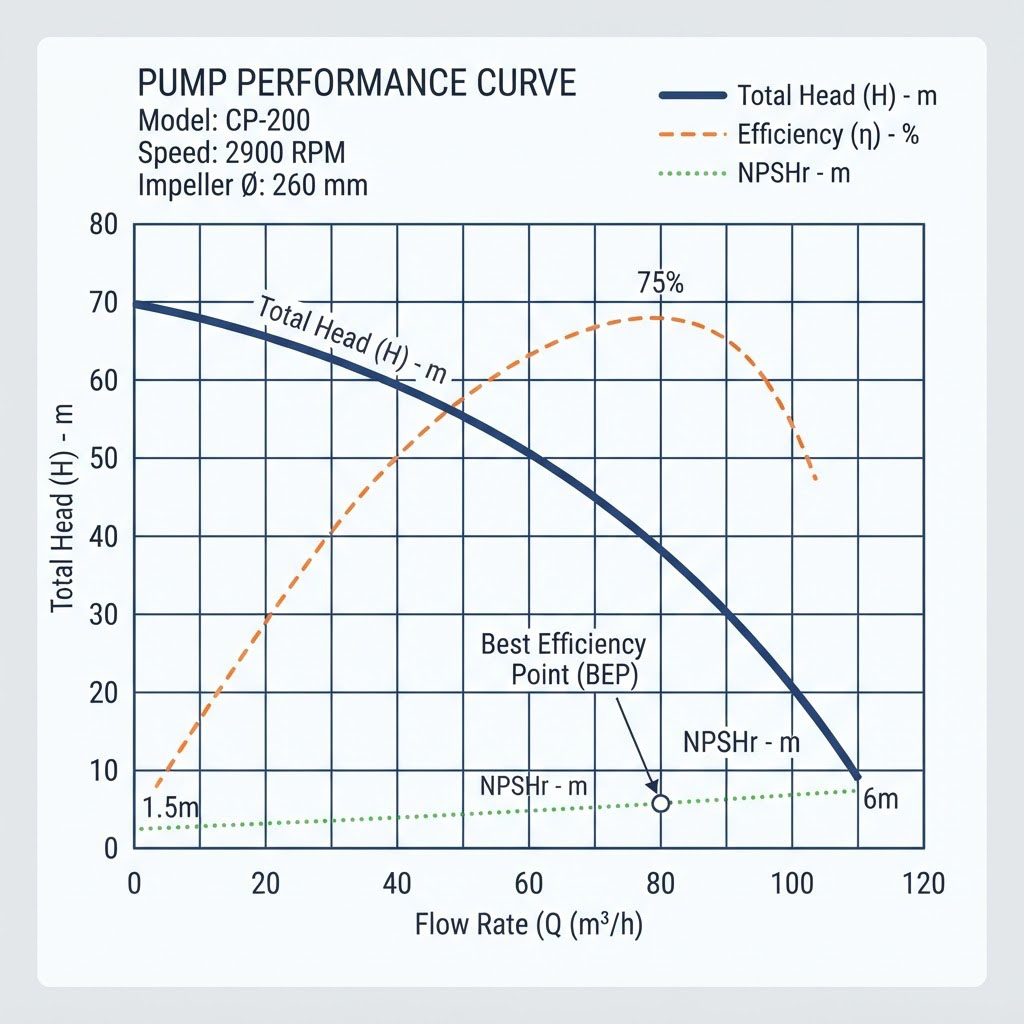
If you purchase or use municipal or industrial pumps, you are required to know the way in which to read pump curves. Pump curves are going to display a pump’s efficiency at particular flow rates and air pressures, helping you establish the ideal pump setup for your application. It’s comparable to verifying the specifications on a light bulb, such as wattage, to guarantee it fits your socket and lighting requirements.
Basic Pump Curve Terminology
Pump curves typically appear as a graph. The X-axis is going to represent flow rate (in GPM or M³/H), and the Y-axis displays discharge pressures (assessed in feet of head). This graph is going to provide critical information concerning how a pump performs at different conditions.
What Does a Pump Curve Tell You?
When inspecting a pump curve, concentrate on the effectiveness curve, which displays the areas in which the pump operates most efficiently at different flow rates. It is preferrable practice to ascertain where the Best Efficiency Point (BEP) is on the curve and set up your pump correspondingly. If your application requirements put the chosen pump below ~70-80% efficiency, you might be required to look for a different sized pump that that is going to give you an increased efficiency rate. The energy that your pump uses should always be taken into account when estimating pump expense since, overall, 85% of a pump’s purchase expense is going to be from the energy it uses.
Understanding NPSHa and NPSHr for Avoiding Cavitation
For avoiding cavitation, guarantee that the pump’s Net Positive Suction Head Available (NPSHa) surpasses the NPSH Required (NPSHr). NPSHa is the accessible suction pressure prior to the liquid entering the rotor and inlet, and NPSHr is the slightest pressure required for preventing cavitation. For instance, if your application requires 400 GPM at fifty-two feet of head, maintain an NPSHa that surpasses the NPSHr curve with at least one to two feet for avoiding cavitation.
Horsepower and Pump Selection
When choosing a motor, take into account the pump’s horsepower prerequisites based on the flow and head. For example, if your application requires 400 GPM at fifty-two feet of head, choose a 10-horsepower motor to address increased load demands. Choose a motor with 1.2x the necessitated horsepower to guarantee dependable performance and stop motor failure.
Final Thoughts on a Pump Curve
A thorough comprehension of pump curves, NPSH, and horsepower specifications is going to help you choose the proper pump for your configuration. Verify its efficiency curves to identify the optimum function range of horsepower, size of the impeller, and Net Positive Suction Head required to guarantee you are making the right decision. With the correct pump selection, you are going to maximize production, decrease maintenance costs, and guarantee extended performance.
If you purchase or use municipal or industrial pumps, you are required to know the way in which to read pump curves. Pump curves are going to display a pump’s efficiency at particular flow rates and air pressures, helping you establish the ideal pump setup for your application. It’s comparable to verifying the specifications on a light bulb, such as wattage, to guarantee it fits your socket and lighting requirements.
Willing Service Corporation Offers A Full Range Of Air Compressors For Sale Nationwide!
Follow our Air Compressor Maintenance Checklist to ensure your air compressor is running its best. Willing Service is proud to sell air compressors nationwide. You can choose the brand, model, and size you need for your purposes and we will ship it straight to your shop or business. Shop industrial air compressors online and get it touch with us today by giving us a call at (602) 246-6940.